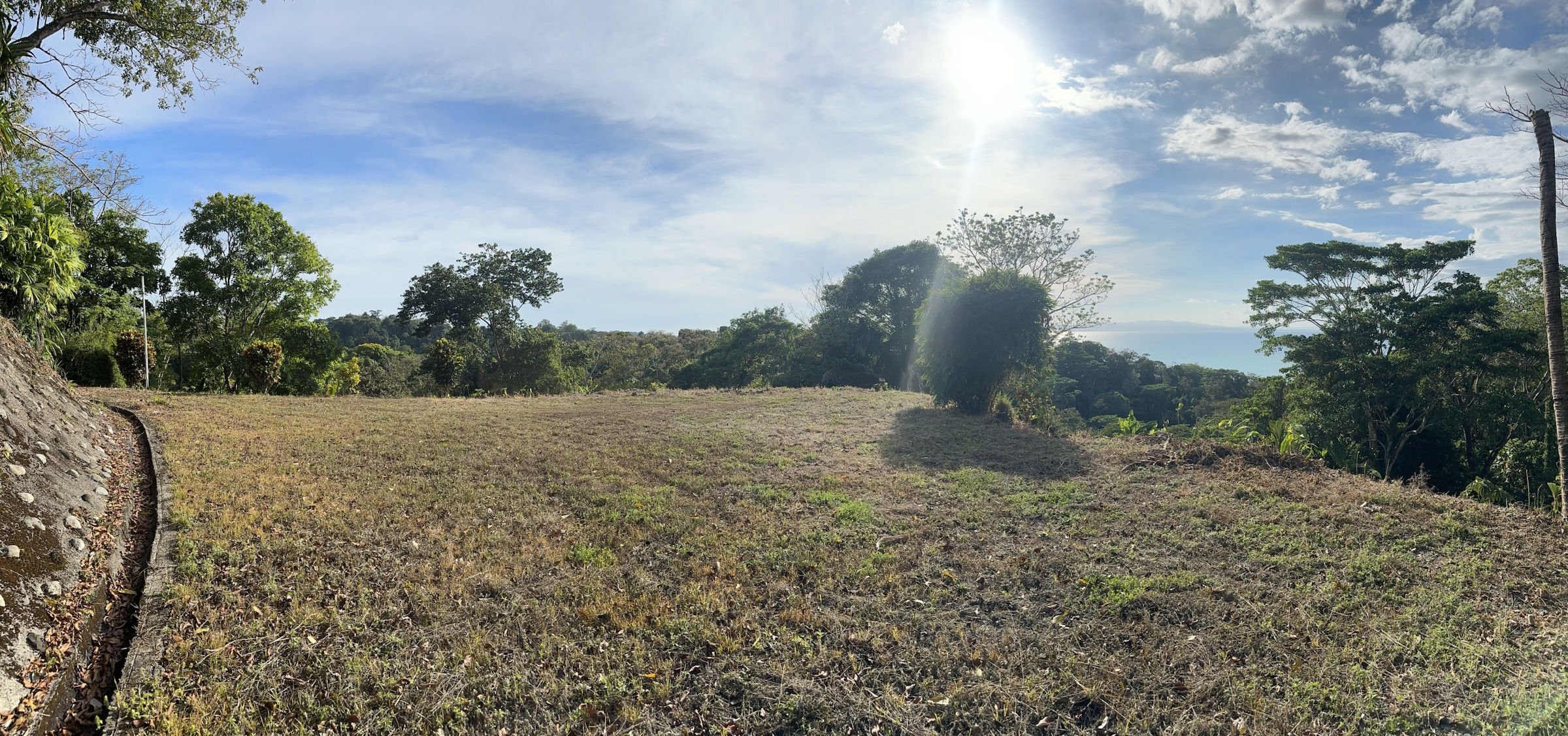
Ask five people what it costs to build in Costa Rica and you will get five confident, incompatible answers. That is because the honest answer has structure: a per-square-metre range that depends on finish level, a permit stack that is predictable, and a site-work budget that depends entirely on the land you chose — the part everyone forgets until the excavator arrives. I prepared my own ridge above Pavones for construction — terraces, walls, drainage, a pool — so I have lived the part of the budget that surprises people most. Here is the whole picture, in 2026 numbers.
As of 2026, sensible planning ranges for the southern Pacific look like this:
Two warnings about those numbers. First, they cover the house — not earthworks, retaining, the driveway, water storage or landscaping. Second, covered outdoor space (the soul of tropical living) is not free: terraces and ranchos typically run 50–70% of indoor cost per metre. A "150 m² house" with 60 m² of terraces is really a 190–200 m² project in disguise.
Costa Rica's permit chain is bureaucratic but well-trodden. You will need a CFIA-registered architect or engineer (the professional college; nothing legal gets built without one) whose design and inspection fees typically total several percent of project value. Plans are filed digitally through the APC platform, the municipality charges a construction-permit tax of about 1% of the declared project value, and construction requires a workers'-insurance policy with INS, the national insurer. Larger or environmentally sensitive projects also pass through SETENA, the environmental secretariat, before anything else. And underneath it all sit two documents that belong to the land, not the project: the municipal uso de suelo certificate and a water availability letter — no water letter, no permit, full stop. For a straightforward home with clean paperwork, permitting typically takes two to four months. Budget roughly 8–12% of construction cost for the whole professional-and-permit layer and you will rarely be surprised.
Here is the number that separates happy builds from horror stories: on sloped tropical land, earthworks, retaining and drainage routinely absorb 10–25% of a total budget — before a single wall rises. Cutting platforms, moving material, building retaining walls, engineering cunetas and culverts so the rainy season passes around your foundations instead of through them, upgrading the access road so a concrete truck can actually arrive: this is real construction, with real engineering, and buyers who chose a "cheap" steep lot discover it the expensive way.
It is also the part of my own story I am proudest of, because on this ridge it is already done. Three terraces cut and stabilised in the disturbed-soil sector, engineered retaining walls, storm drainage, internal gravel roads to each platform — and a working pool on the top terrace. When I say a buyer here skips the hardest year of building in the tropics, this line item is exactly what I mean. The details and documents are on the land & legal page.
Building near Pavones costs a little more than building outside San José, for one honest reason: logistics. Specialty materials travel from the Central Valley or Golfito, specialist trades come from further away, and the rainy season sets the calendar for concrete pours and roof timing. Plan a 10–20% South-Zone premium on mainstream budgets, soften it by using local crews and local materials — block, teak, laurel — and schedule structural work for the drier months between December and April. What you get back for that premium is the reason you came: land prices far below the saturated north, and a view no Central Valley lot will ever have.
This is not off-grid pioneering — the grid is here. ICE runs power along the public road, the local ASADA supplies village water (my land sits 750 m from Rio Claro's services), Starlink has quietly solved rural internet, and a properly built septic system with a drain field handles wastewater, as it does across rural Costa Rica. Many builders add solar and a water-storage tank not out of necessity but because sun is the region's most reliable utility. As a planning figure, $15,000–40,000 covers connections and independence infrastructure for most single-home projects, scaling with distance and ambition.
A 150 m² mid-range home with 50 m² of covered terrace on prepared land: construction roughly $190,000–260,000; professionals and permits $20,000–30,000; utilities and finishing site work $20,000–40,000. Call it $230,000–330,000 all-in — on land where the platforms, retaining and drainage already exist. On raw sloped land, add the site-work line back in and the same house costs $60,000–100,000 more and starts a year later. That difference is precisely the value already buried in this ridge, whether you build one private home or phase a retreat of cabinas across the three terraces.
Costa Rica gives you three ways to organise a build, and the budget behaves differently under each. A maestro de obras — a master builder running a local crew under your architect's inspection — is the traditional route: the most economical, excellent for straightforward concrete construction, and heavily dependent on choosing the right person. A general contractor adds a management layer and a single accountable throat, typically for 10–15% on top. A design-build firm — increasingly common on this coast, often run by bilingual architects — wraps design, permits and construction into one contract; you pay a premium for the coordination, and for owners managing a build from another country it is usually worth every colón.
Labour itself is one of the region's honest advantages: skilled construction wages in the southern zone remain far below North American or European rates, and the craft tradition in concrete, tile and hardwood is deep. Materials tell a similar story — block, cement, rebar and zinc are stocked from Golfito to Rio Claro, and Costa Rican hardwoods like teak and laurel, grown in managed plantations, turn into doors, decks and ceilings that would be luxury imports anywhere else. The rule of thumb that survives every project: build the shell from what the country makes, spend your import budget only where your hands touch daily — kitchens, bathrooms, glass. That single discipline routinely saves owners tens of thousands of dollars, with a result that looks more, not less, like it belongs on this coast.
Keep reading:
As of 2026: roughly $700–1,000/m² for simple local-style construction, $1,000–1,500/m² for mid-range tropical modern, and $1,500–2,500+/m² for high-end architectural builds — plus site work, professionals and permits.
Permitting a straightforward home takes about 2–4 months with clean land documents (uso de suelo, water letter). Construction of a mid-size home typically runs 8–14 months, so plan roughly a year and a half end to end.
The heavy site work is already done — three stabilised terraces, retaining walls, drainage and internal roads. You still complete design and permits (CFIA architect, municipality, water letter), then build on prepared platforms instead of raw slope.
No agents in the middle — ask the price, request documents or arrange a visit, straight on WhatsApp.